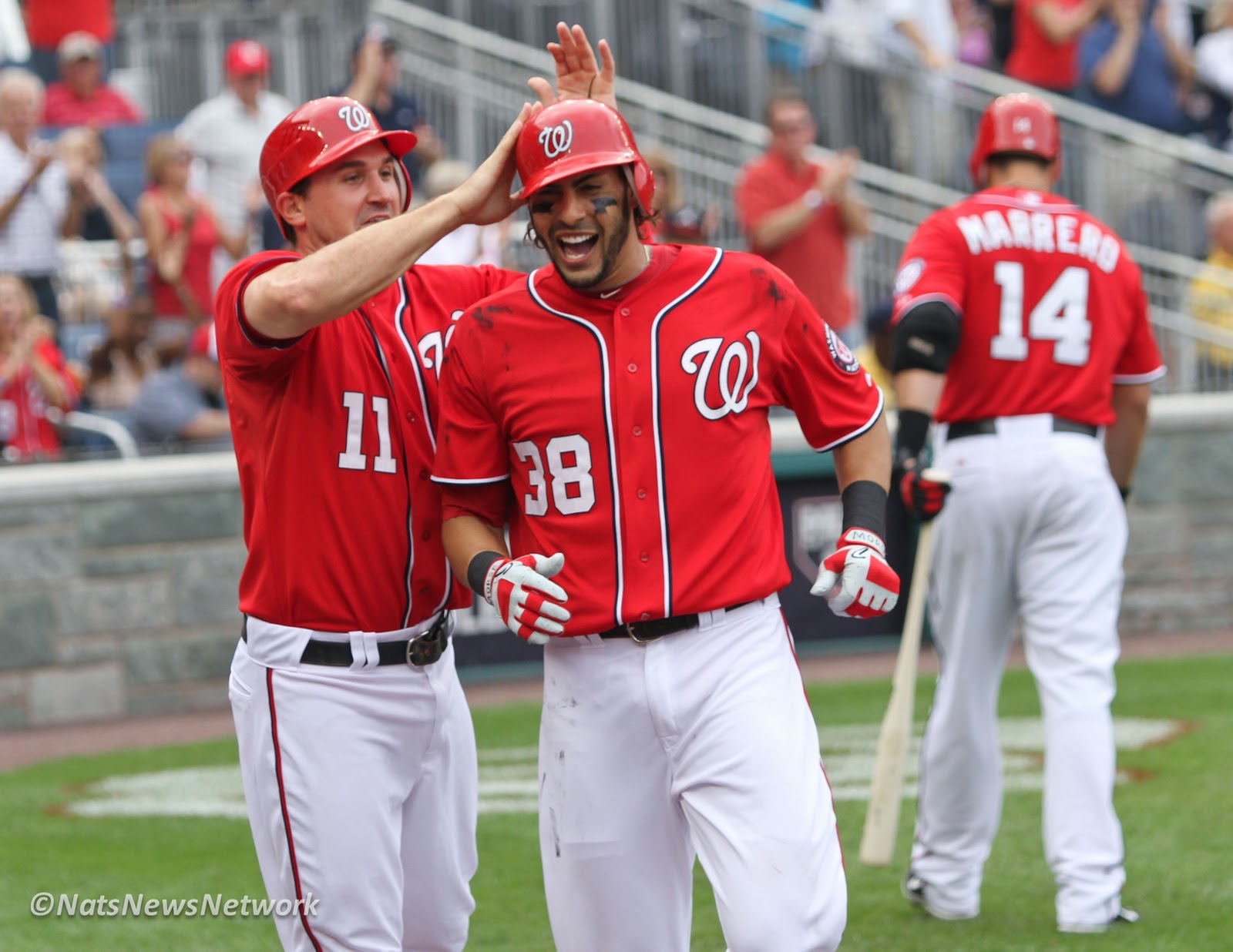
At the end of spring training, I published a post entitled "Nats News Network's 2011 Predictions Edition", and followed that up the next day with "The Great Michael Morse Debate", where I predicted that Michael Morse would be the Nats "Biggest Disappointment" in 2011. That opinion wasn't necessarily based on his projected performance, but Nats fans expectations for Morse heading into the season.
Here's what I said in the predictions post:
I just don't see anything in his history, other than his resemblance to Jayson Werth, that leads me to believe he's going to break out this year any more than he did last season while they were managing his at bats. If he duplicates last year, I'll be happy and surprised.
The next day, I published my 2011 projection for Morse, based on the information we had at spring training and his career ratios:
My official projection for Morse: 380 plate appearances, .272/.337/.461 with 17 home runs. And even then, I'm being optimistic compared to most available independent projections.
I was optimistic against independent projections. Baseball Prospectus had Morse with 302 plate appearances and .277/.341/.458, 15 homers and 41 RBIs. Baseball Forecaster had Morse for 325 plate appearances and .268/.320/.463 with 15 homers and 47 RBIs.
Since he's out of the lineup for today's finale, Morse's final line (not withstanding a pinch-hit chance) is .303/.360/.550 with 31 homers and 95 RBIs in 571 plate appearances. Did he out perform my projection? He sure did. He outperformed every single independent projection as well. But if you look at the HR/PA rate instead of the raw numbers, we're not that far off.
His earned HR/PA rate in 2011 was .0538. My projection was .0447. If you extrapolate my rate over his actual plate appearances, the projection would have been for 25.7 (26) home runs, so my projection for playing time was off more than his production.
In Morse's career before this season, his HR/PA rate was .0306 (21 homers in 685 PAs). In the minors, it was .0227 (69/3039). Last season, it was .0511 (15 homers in 293 PAs). So this season Morse produced at a rate he's never accomplished before in his career.
So how did Morse outperform his projections? His walk rate was down. His K rate was up. His BABiP was above league average, but right on his career average. His platoon numbers are negligible. His line drive percentage, HR/fly ball percentage, everything else is all in line to how he performed last season, which is slightly elevated from his career numbers.
So what was different? Simply playing everyday. He finally found himself healthy and in an organization that overlooked his shortcomings on defense and let him play, first in left field (where he was very below average defensively) then at first base, taking over for the injured Adam LaRoche, where his range was quite suspect, but other than that handled himself pretty well.
Will he continue to produce at this rate? That's very hard to say. He's already at the point where the affects of age will start becoming evident. Some players age better than others. But we can really only expect peak play through the very early 30's and Morse will be 30 at the start of spring training.
Morse made himself a lot of money this season and will be due a huge raise in arbitration this off-season. It will be interesting to see how GM Mike Rizzo treats Morse's salary and contract status the next two seasons. Because if he keeps up this production, when he becomes a free agent at the end of the 2013 season (along with Ryan Zimmerman), he'll be looking at a big, multi-year deal at the age of 32, just like the player Morse believes he most resembles, Jayson Werth.