Showing posts with label PITCHING. Show all posts

"I think he grew up a little bit today." Davey Johnson, on starter Ross Detwiler.

Detwiler delivers in another impressive performance. (photo by Cheryl Nichols)

In his previous start, left-hander Ross Detwiler held the Philadelphia Phillies down for 7 1/3 innings, giving up no runs and just three hits over that period.  What would he do for an encore?  Taking on an Atlanta Braves team fighting for their playoffs lives, Detwiler threw six more shutout innings leading a surging Washington Nationals team past the Braves 3-0, before an appreciative crowd of 37,638 in the last home game of the season at Nats Park.

The Nationals now stand 2 1/2 games above the New York Mets, with three games remaining, for third place in the N.L. East.  With a record of 78-80, if they can somehow continue the hot streak they've been riding for three weeks and sweep the Florida Marlins this week, the Nats would finish above .500 for the first time since the move in 2005.

The Nats have won 13 of their last 17 games.

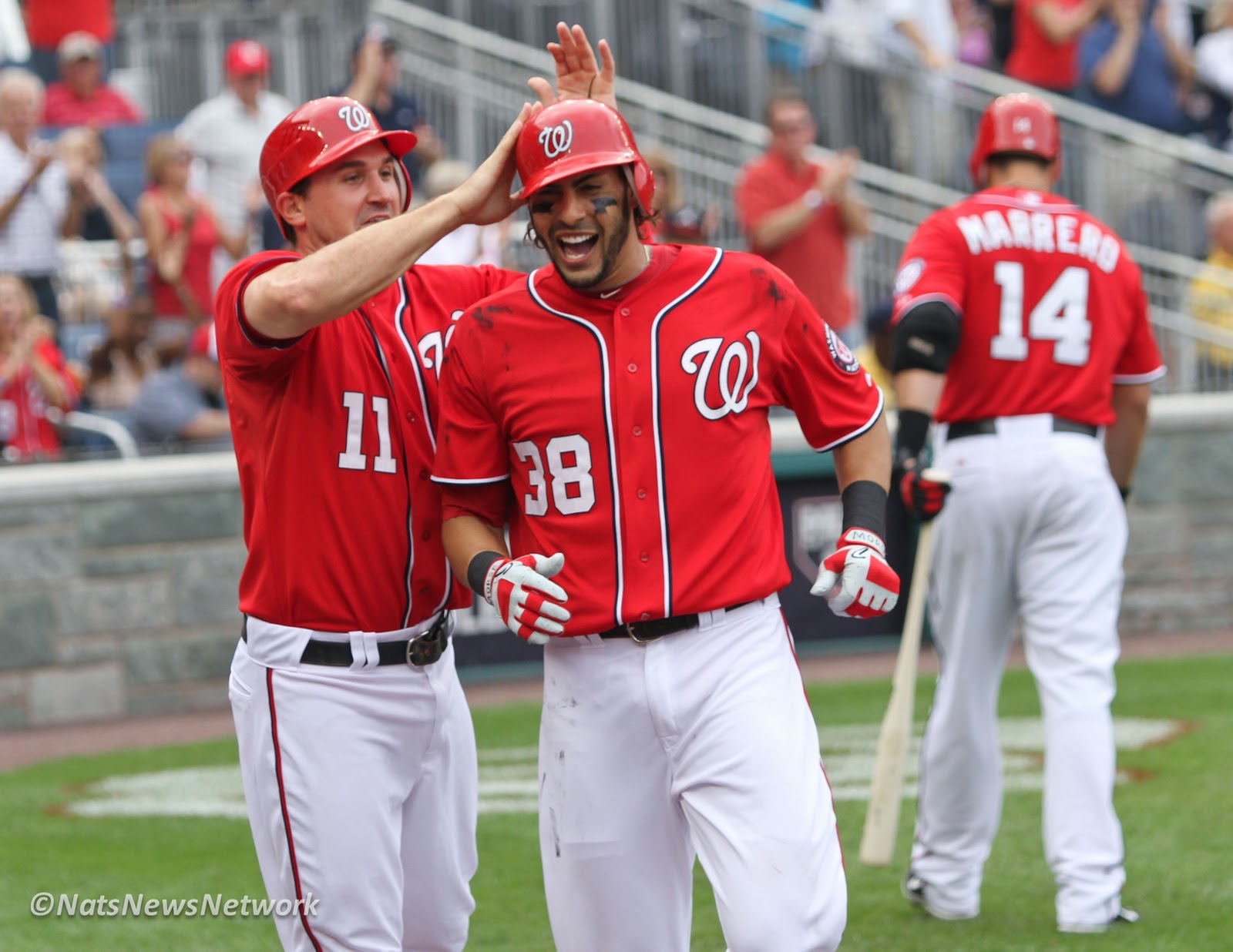
Wilson Ramos and Michael Morse provided all the offense, as each homered to support the cause.  Morse's two-run shot in the seventh was his 29th of the season and prompted a curtain call from the enthusiastic Nats fans.

Morse earned a curtain call for his two-run home run, his 29th of the season. (photo by Cheryl Nichols)

Detwiler cruised through the first two innings, retiring six straight Braves batters.  But all of a sudden in the third inning, Detwiler lost it.  Catcher David Ross lined a single to center.  No. 8 hitter Jack Wilson worked an eight-pitch walk.  Then Detwiler issued a four-pitch walk to pitcher Mike Minor, when the opposing hurler was trying to sacrifice.

But the lanky lefty was able to compose himself.  Two lazy fly balls and a grounder to third ended the inning, stranding all three Braves runners.  Detwiler didn't run into any more problems completing his six innings.  Overall, he gave up just four base hits and walked two, striking out four.  It was a composed and impressive performance from a young pitcher that seems to be maturing before our eyes.

After Detwiler departed, Henry Rodriguez (3 Ks), Tyler Clippard (2 Ks) and Drew Storen (1 K) threw three innings of perfect baseball to seal the win.  Storen recorded his 42nd save of the season.

With all the excitement of Brad Peacock and Tom Milone's progress through the minors and brief success in the bigs at the end of the year, Detwiler's been something of a forgotten man in the rotation.  He's quietly gone 4-5 now with an even 3.00 ERA and 1.26 WHIP in 15 games and 10 starts.

Manager Davey Johnson said after the game those that are writing off Detwiler for next season are making a big mistake.  "There's a lot of guys hungry for this rotation.  The effort that you're seeing is outstanding.  He's definitely in the picture to be in the starting rotation [in 2012]."

"I've seen [Ron] Darling, Sid Fernandez and [Rick] Aguilara, young pitchers with great promise that took longer [to develop].  I know Det had a number of starts last year, but what he's done this year, from being in the bullpen... to back in the rotation, he's pitching to good hitting ballclubs and done okay, held his head above water.  This was probably the biggest game of the year for him, going against this club.  To hold them down to zilch... was a great effort."

The Nats now take back to the road for the final three games of the season in Miami, to close out Sun Life Stadium as a baseball facility.  The Marlins, who will be rebranded the Miami Marlins as part of the agreement the team has with southern Florida lawmakers for public financing of the new stadium, have always been a thorn in the Nats side, this season winning 10 of the 15 games the teams have played thus far.

Regardless of the outcome in Florida, the Nats have already picked up nine games over what they finished with last year, a remarkable 19-game improvement -- so far -- over the last two seasons.  Anything they pick up in Florida is gravy at this point.  But a sweep would complete an utterly improbable run for the .500 mark that has seen the Nationals go 15-9 so far in September.

Small steps.
______________________________________________

THE GOOD:  Michael Morse's home run was to deep right center and provided cushion in the close game.  He went 2-for-3 with a walk.  Wilson Ramos' homer, his 15th of the year, was a line drive shot into the flower bed just above the wall in left field.

THE BAD:  With the Braves losing two of three to the Nats, and the St. Louis Cardinals win over the Chicago Cubs, Atlanta finds their once eight-game lead over the Cards down to one with three games remaining.

THE UGLY:  Chris Marrero had a tough day, going 0-for-4 with two strikeouts and six men left on base.

THE STATS:  9 hits, 2 BBs, 8 Ks.  0-for-10 w/RISP, 8 LOB, zero GIDP.  No errors.

NEXT GAME:  Monday at the Florida Marlins at 7:10 pm.  Tommy Milone (1-0, 3.32) faces Anibal Sanchez (8-9, 3.67).


Chris Marrero disappears after chaing after foul ball. (photo by Cheryl Nichols)

Zim made Gold Glove caliber spin-and-throw in ninth inning. (photo by Cheryl Nichols)

Pudge giving thumbs up to fans after last home game (photo by Cheryl Nichols)

So that happened.


The Washington Nationals continued to play some of their best baseball all year, as Brad Peacock pitched 5 2/3 shutout innings to lead the Nats to a 6-1 win over N.L. East champs -- and bitter rivals -- the Philadelphia Phillies.  The victory completes a four-game sweep in Philadelphia, and moves the Nats to within three games of .500 with six left to play.

The Nationals have won five in a row and 11 of their last 13 games to go to 76-79, with a three-game home series against the Atlanta Braves over the weekend and a season-ending three games series in Miami against the Marlins next week to close out Sun Life Stadium as a baseball facility.

Rollins.  Victorino.  Utley.  Ibanez.  Ruiz.  They were all in the lineup last night that Peacock (2-0, 0.75) fairly dominated.  He allowed just one hit -- an infield single to third -- and two walks, striking out two in 5 2/3 innings, needing just 69 pitches in the process.  Peacock was followed by a parade of relievers that kept the Phillies down, at least until things were well out of hand.

Perhaps the best move of the night came in the bottom of the ninth, when after Doug Slaten retired two lefties to start the frame, manager Davey Johnson came out to lift Slaten to bring in a right-hander, Todd Coffey, to face pinch-hitter John Mayberry.  What was left of the 45,000-plus crowd booed the 68-year old skipper mercilessly for making a pitching change with two outs in the bottom of the ninth of a then 6-0 ballgame, and Johnson relished the entire scenario, lifting his outstretched arms -- palms up -- skyward as if to soak it all in as he left the field, chuckling all the way.

The move, unfortunately, did not have the desired affect in the game, as Coffey gave up a double and single to lose the shutout, but he did get Ben Francisco to pop up to end the game, to more booing for the N. L. East Champions.

The Nats lived off the two runs they pushed across in the third against Roy Oswalt (L,8-10) for most of the night.  Ian Desmond drove home Rick Ankiel on a pop-up double to right center and came home on a Roger Bernadina single.  Bernadina later doubled in the eighth to plate Desmond (2-for-4) again and Michael Morse -- after a visit to the mound -- pounded a 3-2 offering from Oswalt into the center field bullpen for a three-run insurance shot.

Sure, the Phillies had nothing to play for.  But the Nats are trying to finish strong and put a pretty bow on their second-best record since the move in 2005.  No matter who was occupying the uniforms or how much attention they may or may not have been paying, sweeping the Phillies -- in Philadelphia no less -- is sweet music to the long-suffering denizens of NatsTown.

Let them boo.
_____________________________________________________

THE GOOD:  Desmond and Bernadina both had two hits, scored three runs and drove in three between them in the first two spots in the order.  Dare to dream.

THE BAD:  Laynce Nix went 0-for-3 with two strikeouts. 

THE UGLY:  Oswalt.  He pleaded for one more batter after Bernadina's double and a walk to Ryan Zimmerman in the top of the eighth.  Be careful what you wish for.

THE STATS:  7 hits, 2 BBs, 6 Ks.  3-for-9 w/RISP, 2 LOB, 1 GIDP.  E: Zimmerman (11), Bernadina (1).

NEXT GAME:  Friday at 7:05 pm agaisnt the Atlanta Braves.  Stephen Strasburg (0-0, 1.29) faces Tim Hudson (15-10, 3.19).

As the innings on his team-imposed limit rapidly dwindle, and his season draws nearer to a premature -- but inevitable -- conclusion, right-hander Jordan Zimmermann last night once again showed why he's so valuable to the Washington Nationals -- not only in a season when they are trying desperately to show marked improvement record-wise, but to the health and long-term success of The Plan (tm) this franchise put in place when they made Mike Rizzo the General Manager in the wake of Jim Bowden's scandal-filled tenure.

Zimmermann didn't have his good stuff last night; far from it actually.  Regardless, he still dominated a Cincinnati Reds offense that has several very dangerous hitters, leading the Nats to a 3-1 victory on a rainy night at Nats Park.  Though Zimmermann got ahead of hitters all night by pounding the strike zone -- as he does every time he takes the mound -- he had difficulty putting the pesky Reds hitters away, recording just one strikeout on the evening.

But he battled with every one of his 102 pitches, limiting the Reds to six hits and two walks, shutting them out in his 5 2/3 innings of work.  Only one of his hits allowed, a second inning two-out double, was of the extra-base variety.  The only thing that manager Davey Johnson took exception to about Zimmermann's performance was that it just wasn't quite long enough.

Zimmermann's only real "jam" came in his final frame, when he allowed a two-out walk followed by a single that put men on the corners.  Johnson saw enough and called on Ryan Mattheus, who put out the small fire by striking out shortstop Paul Janish.

“I told him after the game, don’t make me have to come out there when you’ve got unfinished business out there," Johnson explained. "I don't like to do it.  He’s too good a pitcher.”  Asked if he considered leaving Zimmermann in after Ryan Hanigan's two-out single though, Johnson replied succinctly, "No."
 
Johnson fully understands both the immediate need to see Zimmermann pitch as he progresses from last year's Tommy John surgery, and the dichotic need to limit the amount of total innings he throws this season.  He needs to pitch deeper into games to build arm strength to assume the lofty status Nats officials think he can hold, but not so much that it places strain on the surgically rebuilt joint -- or other other parts of his arm compensating for the elbow.
 
When asked if it will be difficult to have to shut Zimmermann down once he reaches his innings limit, Johnson was matter-of-fact, "No question about it.  But I got two more starts out of him."
 
Two more starts this season.  That's all fans -- and the organization -- have left to see the Nats burgeoning ace before he's shut down for the winter.  It's been a tremendous season for Zimmermann, better than anyone might have hoped for.  His 8-10 record masks some otherwise truly outstanding peripheral numbers: 3.11 ERA, 1.124 WHIP, 1.6 BB/9 and 4.35 K/BB.  Those are the marks of a staff ace.  And if Stephen Strasburg can make the same progress in his Tommy John recovery that Zimmermann has, the Nats can dream about starting the 2012 season with two aces at the top of their rotation. 
 
It's an enviable position to build a contender from.
____________________________________________________________
 
NATS NOTES:  Mattheus was lifted after just the one batter faced.  He felt tightness in his arm between innings, which Jayson Werth of all people noticed and informed Johnson and pitching coach Steve McCatty.  Mattheus said he felt it lifting weights earlier in the day, and Johnson would not allow him to continue pitching.  Mattheus is listed as day-to-day.
 
Jesus Flores hit a solo home run last night, his first since the night he originally injured his shoulder in 2009.  It's another milestone for the catcher, trying to piece his career back together after missing most of two seasons rehabbing multiple surgeries on the joint. 

With Thursday night’s crushing 6-5 loss to the Atlanta Braves, the Washington Nationals record is one game below .500 at 18-19. They've accomplished this despite being dead last in the league in hitting. So how are they doing it? Primarily with decent starting pitching, (mostly) excellent relief pitching from a few key relievers, and improving defense. The team is 14-9 when not committing an error and 4-10 when they do. That's how close their margin of error has been.

But just how good has the pitching been? Well, they are right at  league average in runs allowed per game at 4.19, and the team ERA is slightly better than average at 3.77. The Nats are fifth in fewest walks allowed per nine and have surrendered the fourth fewest home runs overall, but also next to last in strikeouts per nine. Their ERA+ according to Baseball-Reference.com is league average. They are right in the middle of the pack overall.

There are some pretty fancy stats out there if you really want to get involved with that sort of thing. I like to dabble in them myself from time to time. But pitching is pretty elementary: fewer base runners means fewer runs against. You can use all the new-fangled stats you want, but you can still do a pretty good job evaluating a pitcher by a few simple stats. And you can make a reasonably educated prediction on whether a player is going through a streak or slump just as easily.

All it takes is to know what you're looking for. For general performance, you want to look at hit rates, walk rates and home run rates, and for projection you want to look at BABiP. And you need to compare them to the league average and the player's career average.

Batting Average on Balls in Play (BABiP) measures how many of a batter’s balls in play go for hits (minus home runs). For pitchers, obviously, BABiP against is the percentage of batter balls that fall in for hits against. Typically, around 30 percent of all balls in play fall for hits. This is based on decades of MLB data. This season so far, BABiP across Major League Baseball is .299.

Why is this important? Wildly high or low fluctuation from the norm in BABiP signifies a player in -- or out -- of luck: hits are either falling in or not. But it always goes back to the general norm. From Fangraphs:

If a player has a very high or very low BABIP, it means that whatever the reason for the spike (whether it’s defense, luck, or slight skill), that player will regress back to their career BABIP rates. BABIP rates are flaky and prone to vary wildly from year to year, so we should always take any extreme BABIP rates with a grain of salt.
Hitters can have a little bit of control over their BABiP: fast guys that hit the ball on the ground on purpose, for instance, tend to have higher BABiPs (Nyjer Morgan's career BABiP is .339). But pitchers will hover around that .300 mark. There are obvious outliers, as there always are, and for a more detailed look into the subject, click here.

Let's take a look at the underlying numbers for the starting pitchers so far this season.

Livan Hernandez: 3-4, 4.29 ERA, 1.450 WHIP, 10.2 H/9, 2.9 BB/9, 4.5 K/9, 0.5 HR/9, .318 BABiP
Jason Marquis: 4-1, 3.66 ERA, 1.307 WHIP, 10.0 H/9, 1.7 BB/9, 5.6 K/9, 0.6 HR/9, .327 BABiP
Jordan Zimmermann: 2-4, 4.13 ERA, 1.229 WHIP, 9.0 H/9, 2.1 BB/9, 6.6 K/9, 0.4 HR/9, .307 BABiP
John Lannan: 2-4, 4.79 ERA, 1.597 WHIP, 10.5 H/9, 3.9 BB/9, 4.8 K/9, 0.9 HR/9, .324 BABiP
Tom Gorzelanny: 2-2, 2.87 ERA, 0.903 WHIP, 5.0 H/9, 3.1 BB/9, 6.9 K/9, 1.2 HR/9, .168 BABiP

Those are a lot of numbers to digest. Who are the biggest surprises though? Marquis and Gorzelanny obviously. Can we expect them to continue pitching as well as they have?

Marquis' hit rate and K rate are right in line with his career numbers, but where he shows marked improvement is in his walk rate and home run rate. His career BB/9 rate is 3.5, and he's cut that by almost two walks per game this season. That accounts for his lower WHIP. He's also shaved a half a home run per game off his career home run rate, but he has shown a similar rate in previous seasons. Fewer base runners plus fewer home runs equals lower ERA.

So once those numbers look more like his career numbers, will he go back to his normal mid-4.00 ERA? Not so fast. He's also been pitching in bad luck, if you can believe it. His BABiP is 40 points higher than his career average. Maybe his improved control has him living in the strike zone more and hitters are getting more strikes to hit? Even so, even if his now-stellar walk rate climbs a bit, he should give up fewer bases hits as the season goes along, hopefully maintaining or only slightly elevating his ERA. Verdict: BUY.

Gorzelanny's numbers are downright unbelievable. In 37 2/3 innings, he's given up just 21 hits. His 5.0 H/9 is four full hits below his lifetime average (and 3.5 hits below 2011 N.L. average), and that shows up in his unsustainable .168 BABiP. But Gorzelanny hasn’t invented a new, unhittable pitch. Right now, everything put in play is being hit right at somebody. At some point soon, Gorzelanny's not just going to have a regression, he's going to give up hits at almost double his current rate, which obviously will lead to more base runners and more runs scored against.

One place where Gorzelanny has actually improved is his walk rate, reduced by one per nine over his career average, which is a significant improvement. But his K rate, while close to his career average, is down significantly from the last four years, where he averaged 8.4 per nine innings. On top of all of that, despite his BABiP being incredibly low, his home run per nine rate is up from his career numbers.

It's hard to imagine Gorzelanny continuing this run he's been on. Frankly, it's hard to figure out how he's done it at all. He's yet to give up more than five hits in a start, and he's given up more than two earned runs just once this season (his first start), and in that game he only gave up four hits (two of which were home runs).

Nats fans should applaud Gorzelanny for the string of starts he's made thus far but shouldn't expect it to continue. It's just not statistically possible.

The other three starters -- more or less -- are pitching the way we would expect them to and their BABiPs are all pretty much in line with their career norms. Zimmermann's strikeout rate is down overall, but his 11 K performance Thursday provides optimism, especially the way he was able to generate swinging strikes. Livo's K rate is disintegrating and his home run rate is half his career average, but he's doing pretty much what he always has done. Lannan's walk rate is back up to almost four per nine. Starters that don't strike out a lot of hitters just can't afford to give away free bases and Lannan has the least margin for error of anyone on the staff.

Overall -- barring injury -- I think we can expect most of the staff to continue their performance so far, with the exception of Gorzelanny, as his ERA will rise as the hits start to fall in more. The true test for him is to keep his walk rate down. Hernandez and Lannan should continue to eat innings and keep the team comepetitive when they can limit their walks and Marquis should enjoy his renaissance, hopefully to be flipped for assets as the summer wears on. And all Nats fans should hope Zimmermann continues to regain the command and control necessary to increase his strikeout rate and drop his ERA a little.
___________________________________________________________

One more interesting number to note is "Bequeathed Runners", that is, the number of runners on base when the starter leaves the game.  The Nats far and away lead the league in bequethed runners.  A rough translation means that Nats pitchers wear down in their final inning of work, and manager Jim Riggleman to this point generally hasn't allowed his starters to work out of jams in the middle innings. Not surprisingly, the Nats also lead the league far and away in most bequeathed runners scored.

We saw that in Thursday night's loss, as Jordan Zimmermann was cruising into the seventh, but gave up a walk and a soft line drive single and was pulled in favor of Sean Burnett, who threw gasoline on the fire.  The Nats have the second most "starters wins lost" in the N.L.; when a starting pitcher leaves the game in line for a win and the bullpen gives up the lead.  That speaks to the quality of the middle relief, a topic that seems to be on everybody's minds these days.

WASHINGTON, D.C. -- Washington Nationals starting pitcher Tom Gorzelanny has a history of walking a lot of batters and throwing a lot of pitches.  It's really what has kept him from becoming a reliable starter in the Major Leagues, as he's been sent to the bullpen at points by each of his previous employers.

But last night against the San Francisco Giants, Gorzelanny turned in a masterful performance.  The lefty went eight shut out innings, allowing just three hits and, the most important part, no walks, leading the Nats to a 2-0 win over the defending World Series champs.

"He was just outstanding, very similar to [Jason] Marquis the other night," manager Jim Riggleman said in the post-game. "Really outstanding and good defense behind him. A clean game."

The win secured the series victory as the Nationals took three out of four from the Giants, limiting them to just four runs across the four games.  The Nats now embark on a 10-day, nine-game road trip with their season record at an even .500.

Gorzelanny (W, 1-2, 2.93) was helped out by a struggling Giants squad that was swinging early in counts.  He threw just 95 pitches in his eight innings, 62 for strikes.  He had good movement on his fastball and mixed in a slider that kept the Giants from squaring up on his pitches.  Gorzy benefited from seven groundouts, 11 fly ball outs and four strikeouts.

Riggleman explained why he felt Gorzelanny was so effective. "He just seemed to get the ball down and with movement, you could tell from a lot of the swings that the ball's got some movement tonight and he had a good changeup going to keep guys off-balance. He just had it all working."

He also benefited from some really nice outfield defense, as Rick Ankiel and Jerry Hairston both made plays diving back toward the infield on sinking line drives to rob Giants batters of base hits.

Washington got all the offense they needed in the seventh inning against the Giants young left-hander Madison Bumgarner.  He matched Gorzelanny out for out up to that point, but four consecutive batters reached for the Nats put two runs on the board.

Wilson Ramos snuck a ball under third baseman Miguel Tejada's glove that originally was ruled a hit and changed to an error post-game. Ian Desmond then laced one to the outfield, moving Ramos to third. Michael Morse, who entered the at bat with one hit in his previous 22 plate appearances, sent the first pitch back up the middle to plate Ramos, and Hairston doubled to the right center gap to drive in Desmond.

It must have been a relief for Morse, who looked at strike three to strand a runner at third his previous at bat.  "I know he was disappointed with his previous at bat, you know, man on third," Riggleman said. "I don't know if he got caught looking for something else and Bumgarner made some nice pitches on him. The next time, he was more aggressive and didn't take and was rewarded for it."

In the end, that's all the offense the Nats needed.

Drew Storen entered in the ninth to close the door.  He allowed a walk to Buster Posey, but got Pat Burrell to ground to short to end the game and deliver Gorzelanny's first win of the season. Fans wanted to see Gorzelanny return to try to match Marquis' complete game from Saturday night, but Riggleman went to his closer.

"It's wasn't a no-brainer at all, it was a tough call," Riggleman explained.  "With all the right-handers coming up I felt if anybody gets on I'm gonna have to take [Gorzelanny] out so let's just let Drew start the inning."
____________________________________________________

THE GOOD: Gorzelanny. I was as rough as anyone when the Nats traded for the career underachiever during the off-season.  So far in 2011, Gorzy is limiting his walks and in five starts he has a 2.93 ERA and 23/9 K/BB ratio in 30.2 IP.

THE BAD: The top four hitters in the order combined to go 0-for-12.

THE UGLY: Danny Espinosa.  The rookie is mired in a deep slump (5-for-37 in his last ten games) and went 0-for-4 with three strikeouts.

THE STATS: Four hits, one walk, nine strikeouts. 2-for-5 with RISP, four LOB. No errors.

NEXT GAME: Tuesday at 7:10 pm at Philadelphia Phillies from Citizen's Bank Park.  Livan Hernandez (3-2, 3.23) faces Cole Hamels (3-1, 3.13).

Nats GM Mike Rizzo hasn't landed a pitcher this off-season...yet. (C.Nichols/Nats News Network)

Washington Nationals General Manager Mike Rizzo stated in the fall his top priority this off-season was to acquire a "top of the rotation" starting pitcher for 2011.  The free agent class was remarkably weak in starting pitching this year, and when rumors started floating that it would take $20 million a year to land Cliff Lee, Rizzo conceded that perhaps his lofty goal was unattainable.

Lee eventually signed his lucrative deal with the Phillies, though he reportedly left money on the table to do so.

That left Rizzo to go after a second tier of pitchers, all of whom would have seriously upgraded the Nats staff, widely regarded as one of the worst in Major League Baseball.

Ted Lilly. Javier Vazquez. Hiroki Kuroda. Jon Garland. Jake Westbrook. Jorge de la Rosa. Aaron Harang. Even Brandon Webb.  All second-level starters that would have slotted into the top of the Nats rotation this season, and fit very nicely behind Stephen Strasburg and hopefully Jordan Zimmermann to form a quality rotation for 2012.

The last "impact" free agent starter left standing?  Carl Pavano, and he appears to be headed back to Minnesota.

All went somewhere else.  The Nats were in on some, not on others.  But none are here.

That left Rizzo to pursue a trade for a starter.  He was hot and heavy for Zack Greinke, but lost out when Greinke decided Milwaukee was a more attractive option than Washington, D.C, even when Rizzo had a deal in place and reportedly offered Greinke a boatload of cash in a contract extension.

His next pursuit: Tampa Bay's Matt Garza.  But Garza's been shipped off to the Cubs now, for a decent package of prospects.

***Let me be perfectly clear at this point:  I was not in favor of sacrificing a huge part of the Nationals' future to acquire a starting pitcher via trade.  The prospects that would have been needed to sacrifice for Greinke or Garza would have crippled the Nats franchise for years.  They just aren't deep enough to make those types of trades yet.  Not that it hasn't kept Rizzo from trying.

All of which leaves Rizzo and the Nats at the unenviable position of signing a starter off the scrap heap of what's left in the free agent pool (Jeff Francis? Jeremy Bonderman? Dave Bush?) or (shudder) go into 2011 with the same crew as last year.

Right now, the Nats depth chart at starter is: Livan Hernandez, John Lannan, Jordan Zimmermann, Jason Marquis, and a pool of candidates that will rotate in and out as the fifth starter, led presumably by Yunesky Maya.

How Hernandez did what he did last year (3.66 ERA) mystifies.  In 2008 and 2009 he went 6.05 and 5.44.  Soft-tossing Lannan was sent back to Double-A for a few weeks last year and has a decidely limited ceiling.  Zimmermann is coming off Tommy John surgery and hopefully returns to the promise of his rookie year.  Marquis was indescribably bad (6.60 in just 13 starts) last season.  Maya has dominated Winter League but hasn't played competitively in over two years after defecting and has a flat fastball to go with his array of junk.

After that, it's the same names we're heard for a couple years now, trying to stick at the Major League level:  Garrett Mock coming back from a cervical spine issue.  J.D. Martin, returning from his own back injury.  Ross Detwiler and his hip problems from lousy mechanics.  Chein-Ming Wang and his "football" injury.

Underwhelming.

The rest down on the farm are all too young (or not qualified) to make an impact this year.

Rizzo went out and made adjustments to positions he thought were trouble spots last season.  He acquired Jayson Werth (for the GNP of Austria) to man right field until Bryce Harper ascends, and waited until Adam LaRoche fell to him to get a better glove at first base. And he picked up a couple bullpen arms to add to the competition there.

But he's failed to upgrade the one area on the team that needed it most, despite his apparent acknowledgement and involvement.

The "pitching and defense" mantra only goes so far if you don't have the first part.

Olsen Strong in Rehab Stint in Hagerstown

Posted by Dave Nichols | Sunday, July 18, 2010 | , , , , , | 0 comments »

"I feel outstanding."  Scott Olsen, after his rehab start in Hagerstown Saturday night.


HAGERSTOWN, MD -- Washington Nationals left-handed pitcher Scott Olsen was told before the game he was slated for 65 pitches or four innings in his rehab stint for the Single-A Hagerstown Suns Saturday night.

When his four innings were up he has tossed just 48 pitches -- thanks to a four pitch first inning -- and he was told by Suns' Manager, former National Matt LeCroy, that his time was up for the evening.  He gave a shrug in the dugout with his palms up, a half-hearted plea for another inning.

But Olsen knew there was a plan and knew what was better for him.

"Sometimes it gets frustrating when they pull the cord on you," Olsen told a small group of reporters after the outing, "But at times you gotta understand, sometimes doing things a little slower is better."

Saturday night in Hagerstown, Olsen made another statement to the organization that has been patiently awaiting his return in a 10-3 win for the Suns over their Sally League rival Rome Braves.

The 26-year-old left-hander went on the disabled list following his May 21 start against Altanta.  He had surgery during the offseason on his shoulder, and despite being one of the Nats' stronger starters for a period of several weeks in the spring, the discomfort he was having in the shoulder was just too much to bear on the days following his starts.

Doctors believe the pain was inflamation due to the breaking up of scar material and that there was no further structural damage in the joint.  Several periods of off and on throwing has led to two Gulf Coast League starts, and now the appearance for Hagerstown.

Olsen delivered 48 pitches -- 35 for strikes -- over his alloted four innings.  He allowed one run and two hits to the visiting Rome Braves while striking out four, walking none and hitting a batter.  The run against Olsen came in the fourth inning via a wild pitch.

"So far we've met all my expectations," Olsen said. "[I'm] getting stronger every time out, my velocity is getting more consistent."

Olsen threw all of his pitches in the outing and was generally happy with the results. "We mixed everything in, just trying to get ahead in the count," Olsen said. "Just pound the zone early and get them out with the offspeed stuff."

As with fellow rehabbing starting pitcher Jordan Zimmermann, Olsen is antsy to rejoin his MLB teammates in Washington.

"Being hurt is one of the most frustrating things that you can go through as a player," Olsen admitted. "Then you get this close, you can feel yourself getting ready, and you just want to be there right now."

"You get that itch once you start getting in games again."

After the appearance, he said he felt great, with no pain in his elbow at all during the start, but that the next couple of days he would have to listen to his body.

"Tomorrow and Monday are going to be the two telltale days," Olsen said. "I'll play long-toss [Sunday], 120-150 feet."   If everything feels good, he'll have a normal bullpen session on Monday, where he'll throw 40-50 pitches.

Olsen isn't sure where his next rehab assignment will be yet, but is pretty sure he'll pitch again Thursday.  "I don't know where," Olsen said. "They're probably going to tell me [Sunday]. It might be double-A, might be triple-A."

"We've got another step in another five days," Olsen said, "and we'll go from there."

***Here are a few more photos from Saturday night's action.

Hagerstown Manager, former Washington Nationals Matt LeCroy.

Suns 3B Stephen King couldn't handle this slow roller.

Suns outfielder Destin Hood hit a 3-run home run.

RHP Jordan Zimmermann, recovering from last August's Tommy John surgery, made his second successful rehab start for the Potomac Nationals today, against Carolina League opponent Frederick.

Zimmermann threw 45 pitches in three innings, 30 for strikes.  He did not allow a run and gave up one hit and one hit batter in the three frames.  He struck out five and did not walk a batter.

According to multiple reports, Zimmermann was low-90s with his fastball, and according to MASN.com's Byron Kerr, a scout he spoke with had Zimmermann hit 96 at one point.

The Nationals have been extremely cautious with Zimmermann's recovery, as he is still less than a year out from surgery.  Typically in Tommy John cases, a pitcher takes 12-18 months to get back to the mound, and Zimmermann has had no setbacks in his treatment.

The team does not have a set timetable for his return, but generally, Minor League rehab assignments for Major League pitchers can last up to 30 days (as opposed to 20 days for position players), pursuant to Rule 9(f) of the Major League Rules.

Zimmermann's 30 days would be up August 2.  He could be outrighted to the minor leagues at any point in the rehab assignment if the club felt like he needed more time in the minors to build strength in his arm and regain feel with his breaking balls.

But Nats fans are already envisioning the latter part of August when they can witness Zimmermann's return to a big league mound and be part of a starting rotation with Stephen Strasburg.

Lannan's Struggles: Mechanics, Injury or Dumb Luck?

Posted by Dave Nichols | Monday, June 21, 2010 | , , , | 0 comments »

I find it terribly interesting that a day after the field manager said that he believed in John Lannan -- and that he would take his next scheduled start -- the pitcher was optioned to Double-A.

Lannan has struggled mightily in his last three starts to be sure, where he's given up 31 hits in just 13 innings.  His overall numbers (2-5, 5.76) attest to his inefficiency this season.  However, he did have a four-game stretch in the not too distant past where he allowed two or fewer earned runs in that period, so he's had periods of being "the old John".

But Lannan has always been a different breed of pitcher.  He has never struck anyone out, and his K rate has gone down each of his big league seasons.  In 2009, he had the lowest K rate of any pitcher to qualify for the ERA title.

In fact, Fangraphs.com, a quality analytical website, has dubbed Lannan the "Luckiest Man in Baseball" for his ability to manage a low ERA striking out as few batters as he has in his career.

You can take a look at Fangraphs commentary on Lannan's demotion here. It's illustrative to give you an independent analysis of the situation.

So what's different this year?

Everyone describing Lannan's troubles, from his pitching coach to the new era stat gurus say Lannan's sinker isn't sinking like it used to.  That mechanically, something is wrong that is prohibiting Lannan from generating ground balls.

Lannan missed a start earlier this season with soreness in his elbow.  But everyone in the organization today, including pitching coach Steve McCatty, is strongly saying that Lannan is not injured -- the soreness he experienced earlier this season is not bothering him.

Is it then mental?  Is Lannan altering his delivery to avoid reaggrevating the soreness he experienced earlier this season?  And if he is, is it deliberate?  Or is his body compensating naturally?

From the dugout before tonight's game, McCatty said, "I really don't think he's throwing much differently mechanically." 

McCatty spoke more about Lannan's confidence factor.   "When you're pitching in the big leagues it's awfully tough to go out there and work on something during the game."

"[It’s] just more to get back to that comfort level where you’re not pressing on every pitch to keep them from hitting the ball, or getting a base hit, or worrying about runs and stuff like that."

But here's the thing that the organization has left unspoken that should concern them: as an extreme pitch-to-contact pitcher -- and they don't get much more P-2-C than Lannan -- all those ground balls that have been hit at fielders that last couple of years could simply just be missing them this year.

Take Sunday's start, in which he gave up five earned runs on 11 hits.  Lots of hits, yes.  But he threw strikes (51 of 69 pitches were strikes) and he didn't walk a batter.  Additionally, Lannan got eight ground ball outs, as opposed to two fly ball outs.  Of the 11 hits, there was just one extra-base hit -- Alex Rios' RBI double in the fifth inning.

Honestly, the only thing different about yesterday's start from any of Lannan's starts the last couple of years is the result.  The ground balls were there.  They were just getting through.

If it's just a slight mechanical tweak that Lannan needs to make in order to restore the action on his sinker enough so that hitters don't square up as much on the pitch, then he'll back in the bigs relatively quickly.  And if he IS injured, we'll find out even quicker.

But if it's simply the case in his last three starts that ground balls are finding the holes that weren't the last two years, then Lannan -- and the Nats -- have a whole different problem.

You have to hope that a guy that the team was depending on -- the 25-year old consecutive year Opening Day starter -- figures something out in the minors and returns to being the same pitcher he was the last two seasons.  But if you can't miss bats in the big leagues, your margin of error is mighty thin.

Lannan found out how thin earlier this afternoon.

Today, Tom Boswell writes about how Stephen Strasburg is on pace to obliterate strikeout records, akin to the great strikeout artists in the history of the game.

The title of the column is "Can Stephen Strasburg resist the urge to become a strikeout king?" and he concludes,
Will this ultra-high-strikeout pattern, one that nobody -- even the Nats and Strasburg themselves -- anticipated just one week ago, continue? Should we even want it to? No one knows. But you can bet we'll be waiting, every five days, to find out.
The answer is simple:  Yes.  Strasburg, the Nats, and Nats fans should want the strikeouts to continue.

Will Strasburg continue striking out batters at a rate of 16.1 per nine innings?  No, he won't.  That's outlandish.  But he appears to have several different, legitimate strikeout pitches, which is incredible in its own right.

Nats Stats (who does very good work) compared Strasburg's first two starts with regards to pitch type/location, etc.  He concluded that Strasburg was overthrowing his two-seam fastball--his sinker--throwing it out of the strike zone much of the day.  Indians hitters only swung at two of the 16 he threw.

While Strasburg was in the minors, it's obvious that the team instructed him to put away his big, four seam fastball, the one that touches 100-MPH.  He was instructed to go out and work on the two-seamer, get ground balls, concentrate on baseball situations, etc.

Once Strasburg reached the big leagues though, catcher Ivan Rodriguez has called for the heater much more often.  It's like Strasburg is a new Ferrari, and Pudge wants to see what he can do.  Against Cleveland, Strasburg threw 38 four-seamers compared to 22 two-seamers.  In his debut, the breakdown was even more drastic:  49-9. 

Some of this may be noise in the Pitch F/X data, but one thing is clear:  he's throwing the four-seam fastball much more often than he did in the minors, and that's because Rodriguez is calling for it.  He knows how effective the pitch is.

Boswell seems to be espousing a popular theme in baseball that strikeouts = higher pitch counts = bad for starting pitchers.  If he is, he's wrong.  It's always better to record an out when the ball is not put in play.  There are so many factors to recording an out after a ball is put into play, not the least of which is team defense.

Oh, by the way, the Nats lead the league in errors and are high on the list of unearned runs.

There are lots of studies available that discuss strikeout efficiency and defense of the "pitch to contact" rationale.  A very good one is here, written by 3-D Baseball in language that most casual baseball fans can grasp.  The upshot is:
...a pitcher who already has good control has no reason to cut down on his strikeouts purely to reduce his pitch count, as he generally won't see any noticeable results.
You see, strikeouts don't raise pitch counts, walks do.  It's really that simple.

The basic premise--usually purported by managers or general managers that don't have strikeout pitchers in their system--is that by "pitching to contact", you can get an out with one pitch as opposed to three pitches "going for" a strikeout, thus drastically reducing a pitcher's pitch count, making them more efficient and saving them from injury. 

But statistically, and we have plenty of years of data to back this up, it does not correlate. 

Rather, there is no statistical evidence to suggest that "ground ball" pitchers use less pitches overall than "strikeout" pitchers.  Again, from 3-D Baseball: 
As our data suggests, there is no emerging pattern that either high strikeout pitchers or high contact pitchers require more pitches to get through 9 innings. For the most part, it doesn't matter how frequently a Major League pitcher strikes out hitters or how frequently he allows hits as to how many pitches he has to throw. The trade offs of one compared to the other mostly cancel out.
-snip-

Simply put, by far the strongest factor in how many pitches a pitcher needs to get through an inning is how frequently he walks batters. Almost every time you hear a broadcaster or analyst talk about how a pitcher throws too many pitches because he strikes out too many hitters, the real reason will be because the pitcher walks too many hitters, not that he strikes out too many...
We saw clear evidence of this in Strasburg's two starts.  Against the Pirates, he walked no one, struck out 14 and cruised through the seventh inning in 94 pitches.  Against the Indians (a team that is significantly more patient at the plate), Stras struck out eight, but walked five and only got through 5 1/3 in the same relative number of pitches (95).


It wasn't the strikeouts that did him in (PIT), it was the walks (CLE).

In his history, there's nothing to suggest that Strasburg will have anything but impeccable command.  In college, and the minors, he never had a game with more than three walks.  He's facing better hitters now, but he also had considerable trouble with the mound in Cleveland.  Let's get a few more data points.

But Pudge has it right.  If you can strike batters out while limiting your walks, you will be a better pitcher.